
By Tricia M. Taitt, Fractional CFO and Author of Dancing with Numbers
At FinCore, we empower small business CEOs to grow and scale financially healthy businesses so they can exit successfully.
Preparing for exit? We strengthen your financial core (financial systems, people & numbers) so your company is more attractive and valuable.
Sign up here for a discovery call.
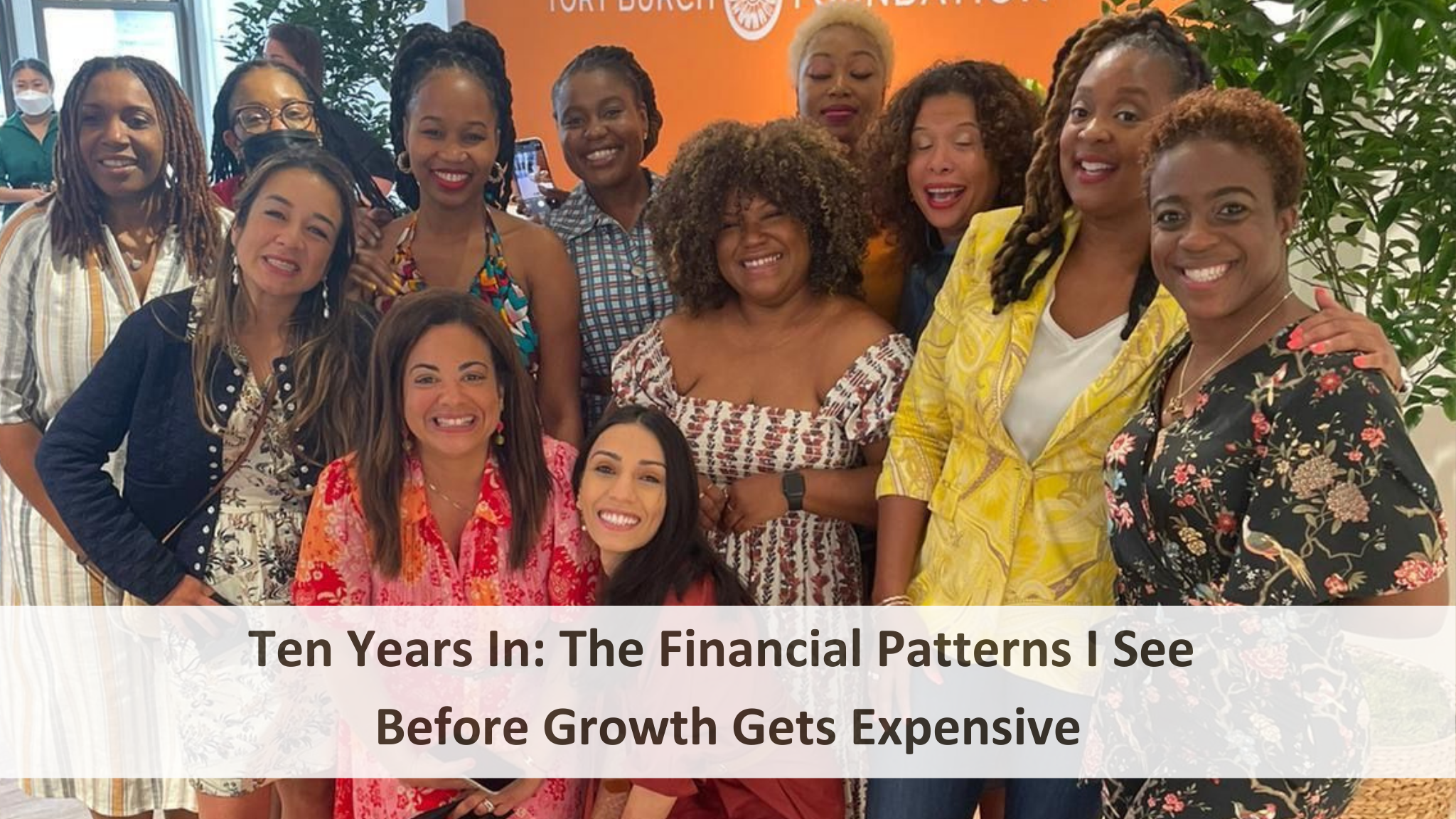
Next week, FinCore turns 10. 🥳
Reaching 10 years in business has given me the gift of perspective.
Not just on my own journey, but on the recurring financial and operational patterns I’ve watched play out across hundreds of growing companies.
If there’s one lesson a decade in the work has reinforced, it’s this: trouble rarely comes out of nowhere. It leaves a trail if you know how to read it.
The founders who get into trouble aren’t reckless. They’re usually growing, ambitious, values-driven and moving fast.
Growth Has a Sound Before It Has a Crisis
At the $2–$20MM stage, trouble doesn’t announce itself as failure.
It shows up as:
- Stretched cash flow that “should catch up soon”
- Decisions made on intuition because the numbers lag
- Excitement about growth opportunities without a clear financial container
By the time the pain is obvious, the cost of fixing it is much higher.
Here are a few real patterns I’ve seen across very different businesses.
Pattern #1: Values Without Financial Guardrails
An organic beauty and skincare company wanted to stay deeply aligned with its brand values.
They invested in:
- Beautiful, premium packaging
- Increased marketing spend
- Hand-made production to preserve integrity
All good intentions, but there was no clear understanding of:
- Unit economics
- Cash conversion cycle
- How much working capital was required to sustain that model
The result?
Sales grew but cash quietly disappeared.
Values matter, but without financial leadership, values can unintentionally burn down cash flow.
Pattern #2: Growth Capital Without Balance Sheet Readiness
An event production company wanted to raise $500K to buy a physical space.
The vision made sense and the revenue was there.
But the balance sheet didn’t reflect the true economic value of the business:
- Assets weren’t properly represented
- Liabilities were understated
- Owner investment and retained earnings were unclear
They weren’t “denied” because the business was weak, but because the financial story wasn’t lender-ready.
Capital doesn’t just care about growth, it cares about structure.
Pattern #3: Sophistication Without the Right Financial Team
Even at the highest levels, these patterns show up.
Pinky Cole, founder of Slutty Vegan, has been open about nearly losing majority ownership of her business.
Not because the brand wasn’t successful, but because the right financial safeguards weren’t in place early enough.
Thank God they caught it.
That moment is a powerful reminder: Growth doesn’t eliminate risk. It often introduces new kinds of it.
The Pattern I Recognized in My Own Business
Around the halfway point of my own 10-year journey, I had to confront a hard truth:
The market I originally built for was no longer the market I was best positioned to serve.
I had grown.
My skills had deepened.
The problems I was solving had changed.
But my positioning hadn’t fully caught up.
Reassessing my product-market fit, and getting crystal clear on who my clients really were and what they truly needed, was uncomfortable.
It was also necessary.
That refinement is what gave FinCore its next chapter, and its staying power.
Why This Matters (Especially During Black History Month)
Black History Month reminds us that progress, financial and otherwise, is rarely linear.
Only about 30% of small businesses make it to year ten.
For Black-owned businesses, that number is closer to 20%.
And representation in financial leadership remains limited:
Across the Fortune 500, S&P 500, and Russell 1000, there are only about 21 Black CFOs documented today, with even fewer being Black women.
Those realities don’t discourage me, they sharpen my purpose.
They reinforce why I bring financial discipline, clarity, and foresight to growth-stage businesses, so founders don’t lose control of something they worked too hard to build.
The Reframe for Growth-Oriented Founders
Most businesses don’t need to be “fixed,” they need to pay attention earlier.
Earlier to:
- Cash flow strain
- Balance sheet weakness
- Misaligned entity structure (LLC vs S-Corp decisions matter more as you grow)
- The absence of a proactive financial partner
The earlier you respond, the cheaper the solution.
A Simple Reflection
Ask yourself:
- Where am I seeing friction, but explaining it away?
- Which decisions am I making without full financial visibility?
- What would be easier if I addressed this now instead of later?
Problems don’t appear suddenly, they leave clues.
The founders who win long-term are the ones who listen.
Pay attention earlier. It’s cheaper.
Tricia M. Taitt
Author of Dancing with Numbers

Tricia Taitt is the CEO and Chief Financial Choreographer of FinCore. She holds an M.B.A from The Fuqua School of Business of Duke University, and a BS in Economics with a Finance concentration from The Wharton School at the University of Pennsylvania. For over 20 years, she’s been a finance professional. Half of the time was spent working on Wall Street while the other half was spent in the trenches side by side with small business owners. As a result of working with FinCore, clients have been able to take control of their numbers and feel more confident in their ability to make decisions, while increasing profits by 10% and building a cash stash to invest in growth. Follow Tricia on LinkedIn and Instagram.